
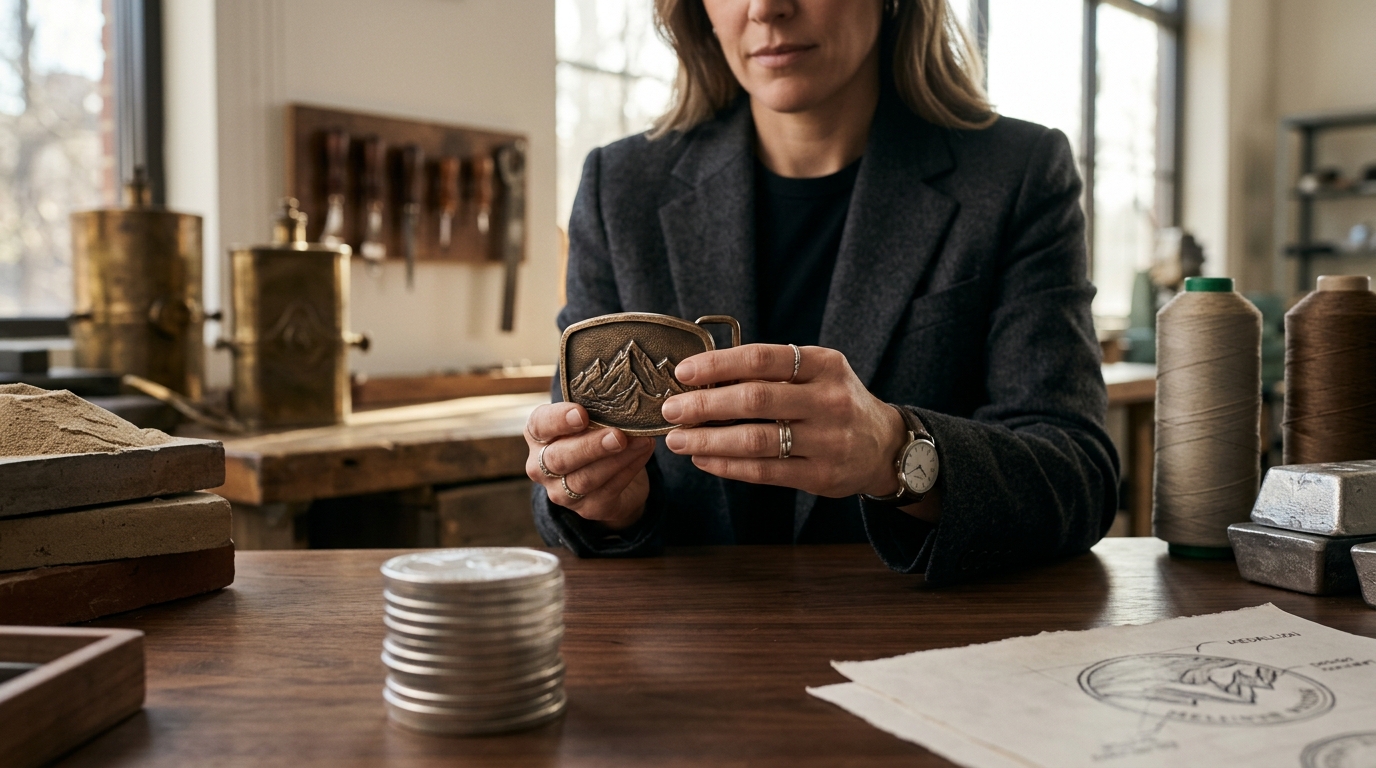
Choosing the right manufacturing process is the single most critical decision when producing branded metal goods. According to industry data, the choice between traditional custom sand casting and high-pressure die casting can determine whether your project succeeds in detail or fails in cost. For organizations seeking premium brand identity, the method selected must align with both aesthetic requirements and volume goals. This guide dissects the operational differences to help you make an informed choice.
Core Differences in Process
Understanding the fundamental mechanics of each method is essential for accurate project planning. The primary distinction lies in how the molten metal is introduced into the mold cavity.
Custom Sand Casting Mechanics
Custom sand casting, often referred to as investment casting or lost-wax casting in premium contexts, involves creating a wax pattern that is encased in a ceramic shell. This shell is then heated to melt out the wax, leaving a hollow cavity. Molten metal is poured or centrifuged into this void. Industry reports indicate that this method allows for exceptional geometric complexity because the mold is destroyed to remove the part, enabling intricate undercuts and fine details that rigid molds cannot achieve.
Die Casting Mechanics
Die casting utilizes a reusable steel mold, known as a die, into which molten metal is injected at high pressure. This process is designed for speed and repeatability. The high pressure ensures that the metal fills even the smallest details of the die quickly. However, the rigid nature of the steel die limits the complexity of the geometry. Parts must be designed with draft angles to allow for ejection, which can restrict certain aesthetic designs.
Detail and Surface Finish
For brands producing medallions, coins, and lapel pins, visual fidelity is paramount. The surface finish directly impacts the perceived value of the final product.
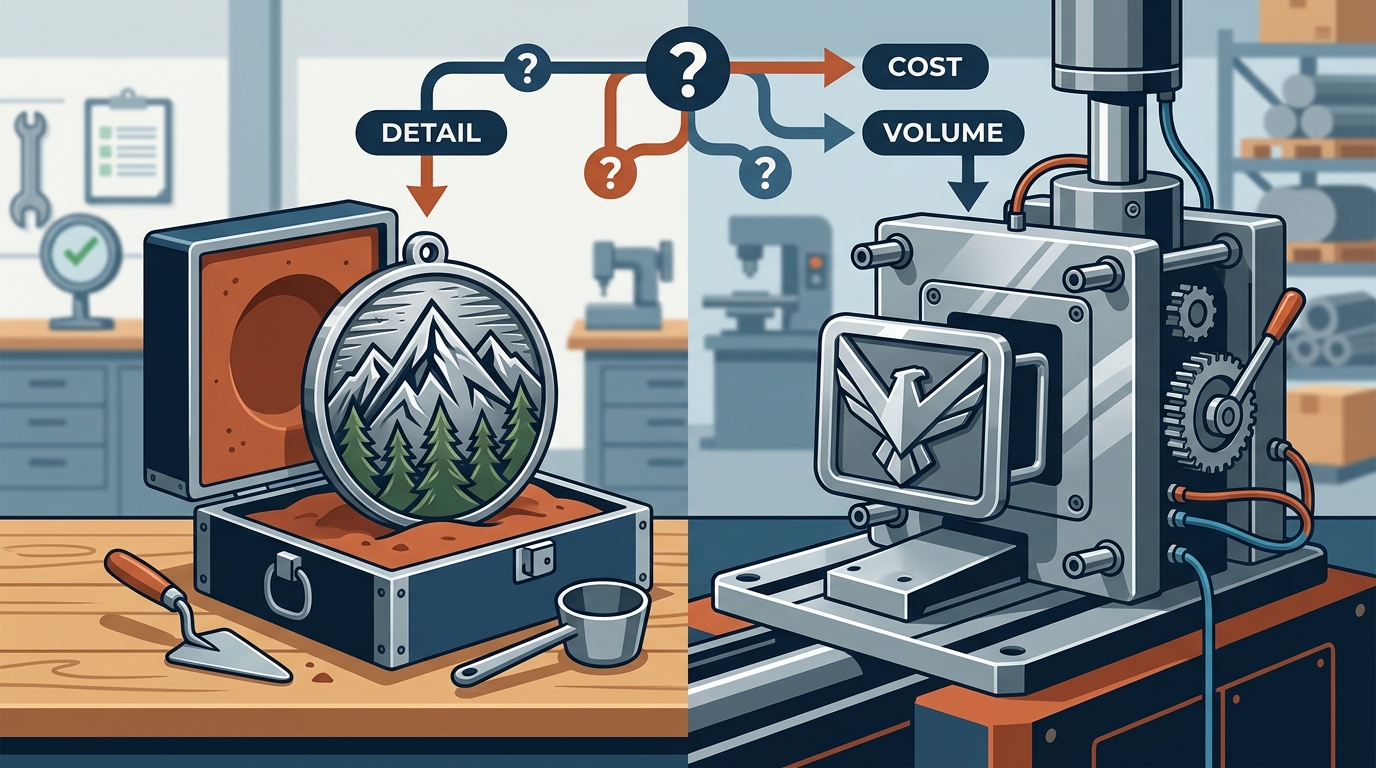
Superior Detail in Custom Castings
Custom castings are renowned for their ability to replicate microscopic details. When you submit a design to Mountain Medallion Design Services, the wax model captures every nuance of the original artwork. This is why custom castings are the preferred method for high-end collectibles and commemorative items where texture and depth are critical. The surface finish is typically smooth and ready for polishing, plating, or enamel filling.
Consistency in Die Casting
Die casting offers incredible consistency across large batches. Once the die is perfected, every subsequent part will be identical. However, the surface finish may require additional machining or deburring to remove gate marks and flash. For simple, bold graphics on buckles or hardware, die casting provides a clean, uniform look that is difficult to achieve with manual sand casting processes.
Cost Analysis: Tooling vs. Unit Price
The financial structure of these two methods is fundamentally different. One requires high upfront investment, while the other relies on lower initial costs but higher per-unit expenses.
High Tooling Costs for Die Casting
Die casting requires the fabrication of a hardened steel die. This tooling is expensive and time-consuming to produce. Manufacturing data shows that die costs can range from thousands to tens of thousands of dollars depending on complexity. However, once the die is created, the cost per unit drops significantly, making it highly economical for high-volume production runs.
Low Tooling for Custom Castings
Custom sand casting has minimal tooling costs. The primary expense is the creation of the wax pattern and the ceramic shell, which are relatively inexpensive compared to steel dies. This makes custom castings ideal for low to medium volume orders. While the cost per unit is higher than die casting in large volumes, the lack of massive upfront investment makes it the smarter financial choice for startups and limited editions.
Material Options and Durability
The choice of material affects both the aesthetic and the functional performance of the final product. Both methods offer a range of alloys, but their suitability varies.
Versatility of Custom Castings
Custom castings can accommodate a wide variety of metals, including bronze, brass, aluminum, zinc, and precious metals like silver and gold. This versatility allows brands to choose materials that best fit their budget and aesthetic goals. Technical studies confirm that bronze and brass castings offer superior corrosion resistance and durability, making them ideal for outdoor medallions and heavy-use buckles.
Aluminum and Zinc in Die Casting
Die casting is predominantly used with aluminum and zinc alloys. Aluminum die castings are lightweight and strong, making them suitable for automotive and aerospace components. Zinc die castings offer excellent strength and can be easily plated. However, die casting is less suitable for precious metals due to the high melting points and reactivity with the steel die, which can degrade the tooling over time.
Volume Scaling and Lead Times
Time to market is a crucial factor for product launches. The scalability of each method impacts your ability to meet demand.
Speed of Die Casting
Die casting is incredibly fast. Cycle times can be measured in seconds, allowing for the production of thousands of parts per day. This makes it the only viable option for mass-market products where speed and volume are the primary drivers. If you need 100,000 identical buckles in a month, die casting is the clear winner.
Lead Times for Custom Castings
Custom castings have longer lead times due to the manual steps involved in pattern making, shell building, and finishing. However, for orders under 10,000 units, the difference in total project time is often negligible. Mountain Medallion Contract Sales specializes in managing these timelines to ensure timely delivery for commemorative events and product launches.
Comparison Summary
| Feature | Custom Sand Casting | Die Casting |
|---|---|---|
| Best For | Low to medium volume, high detail | High volume, simple geometry |
| Tooling Cost | Low | Very High |
| Unit Cost | Higher at scale | Very Low at scale |
| Detail Level | Exceptional | Good, but limited by draft angles |
| Material Options | Broad (including precious metals) | Limited (Aluminum, Zinc) |
| Lead Time | Longer setup, consistent production | Long setup, rapid production |
Key Takeaways
- Detail Priority: Custom castings are superior for intricate designs, such as those found in Mountain Medallion's product gallery, where fine lines and textures are essential.
- Cost Efficiency: Die casting becomes cost-effective only after significant volume thresholds are met, typically exceeding 10,000 units.
- Material Flexibility: Custom casting allows for the use of bronze, brass, and precious metals, which are not feasible for standard die casting.
- Brand Identity: The unique character of custom castings enhances brand perception, making them ideal for limited edition collectibles.
- Scalability: Die casting offers unmatched speed for mass production, while custom casting offers flexibility for variable order sizes.
- Tooling Investment: Avoid high upfront tooling costs for new product lines by starting with custom castings.
- Quality Standards: Both methods can achieve high quality, but custom castings require more skilled finishing labor.
Frequently Asked Questions
What is the minimum order quantity for custom castings?
Custom castings can be produced for very low quantities, often starting at just a few dozen pieces. This makes them ideal for prototypes and small batches.
Can die casting be used for precious metals?
Generally, no. The high temperatures and reactivity of precious metals can damage the steel dies. Custom casting is the preferred method for gold, silver, and platinum.
How long does the tooling process take for die casting?
Die tooling can take several weeks to months to design and manufacture, depending on the complexity of the part.
Is custom casting more expensive than die casting?
For small to medium volumes, custom casting is more cost-effective due to lower tooling costs. For very large volumes, die casting offers a lower per-unit price.
What materials are best for outdoor medallions?
Bronze and brass are the best materials for outdoor medallions due to their natural corrosion resistance and ability to develop a patina over time.
Can I get a sample before full production?
Yes, most manufacturers offer prototype samples. Mountain Medallion provides detailed quotes and samples to ensure client satisfaction before full-scale production.
What is the difference between sand casting and investment casting?
Sand casting uses a sand mold, while investment casting uses a wax pattern and ceramic shell. Investment casting offers finer detail and smoother surfaces, making it ideal for jewelry and medallions.
Start Your Project
Whether you need a single prototype or a thousand custom pieces, the right manufacturing partner makes all the difference. Mountain Medallion has been delivering quality custom American-made castings since 1999. Our team of experts is ready to help you navigate the complexities of design and production. Contact us today for a free estimate and discover how we can bring your vision to life.